Airfoil Geometry and Aerodynamics
Level: Beginner
This notebook introduces NACA airfoil geometry and fundamental airfoil aerodynamics using thin-airfoil theory.
Topics covered
NACA 4-digit and 5-digit airfoil geometry generation
Airfoil coordinate visualization
Thickness and camber distributions
Lift coefficient vs. angle of attack (thin-airfoil theory)
Effect of camber and thickness on aerodynamic performance
Prerequisites
Basic Python and NumPy familiarity
Elementary aerodynamics concepts (lift, drag, angle of attack)
References
Abbott, I.H., and Von Doenhoff, A.E., Theory of Wing Sections, Dover, 1959
Anderson, J.D., Introduction to Flight, McGraw-Hill, 2016
[1]:
# Standard library imports
import numpy as np
import matplotlib.pyplot as plt
import matplotlib.gridspec as gridspec
import sys
import os

print("Setting up environment...")
print(f"Current working directory: {os.getcwd()}")

# Resolve project root from this notebook location and add src/ to import path
notebook_dir = os.getcwd()
project_root = os.path.abspath(os.path.join(notebook_dir, "..", ".."))
src_root = os.path.join(project_root, "src")

print(f"Resolved project root: {project_root}")
if not os.path.isdir(src_root):
    raise FileNotFoundError(f"Could not find src directory at: {src_root}")

if src_root not in sys.path:
    sys.path.insert(0, src_root)

print(f"Using src path: {src_root}")
from aerodemo.naca_airfoil import NACAFourDigit, NACAFiveDigit

# Matplotlib style
plt.rcParams.update({
    'figure.dpi': 100,
    'axes.grid': True,
    'grid.alpha': 0.3,
    'font.size': 11,
})
print("Setup complete.")
Setting up environment...
Current working directory: f:\agodemar\AeroDemonstrator\notebooks\01_airfoil
Resolved project root: f:\agodemar\AeroDemonstrator
Using src path: f:\agodemar\AeroDemonstrator\src
Setup complete.
1. NACA 4-Digit Airfoil Geometry
The NACA 4-digit series is defined by:
1st digit: maximum camber \(m\) as percentage of chord (0–9%)
2nd digit: location of maximum camber \(p\) in tenths of chord (0–9)
Last 2 digits: maximum thickness \(t\) as percentage of chord
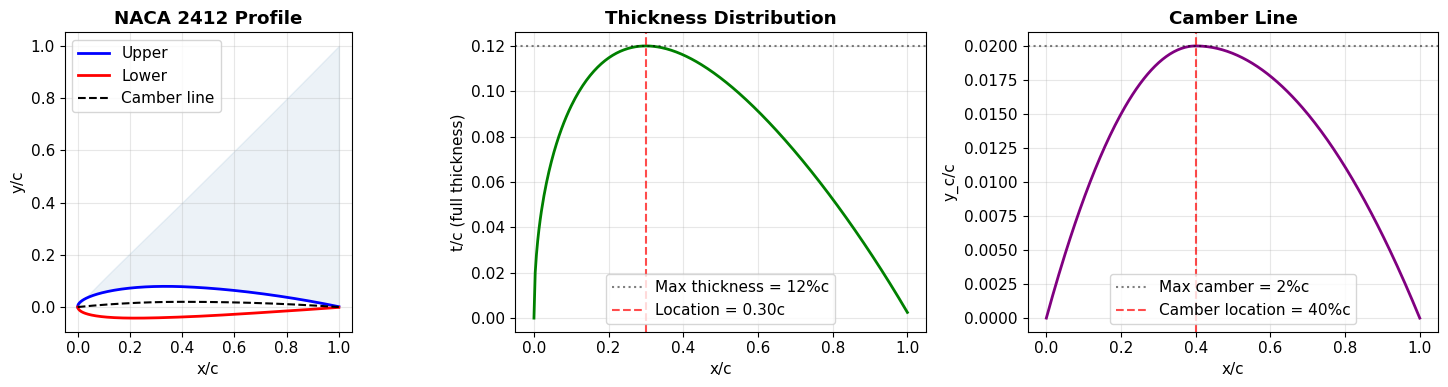
For example, NACA 2412 has:
\(m = 0.02\) (2% camber)
\(p = 0.4\) (camber at 40% chord)
\(t = 0.12\) (12% thick)
The thickness distribution formula (Abbott & Von Doenhoff) is:
[2]:
# --- Generate a family of NACA 4-digit airfoils ---
designations_4digit = ['0006', '0009', '0012', '2412', '4412', '2415']

fig, axes = plt.subplots(2, 3, figsize=(14, 7))
axes = axes.flatten()

for ax, des in zip(axes, designations_4digit):
    af = NACAFourDigit(des, n_points=200)
    xu, yu, xl, yl = af.coordinates()

    ax.plot(xu, yu, 'b-', linewidth=1.5, label='Upper surface')
    ax.plot(xl, yl, 'r-', linewidth=1.5, label='Lower surface')
    ax.fill_between(xu, yu, xl, alpha=0.08, color='steelblue')
    ax.set_aspect('equal')
    ax.set_title(f'NACA {des}', fontsize=12, fontweight='bold')
    ax.set_xlabel('x/c')
    ax.set_ylabel('y/c')
    ax.set_xlim(-0.05, 1.05)
    ax.legend(fontsize=8, loc='upper right')

plt.suptitle('NACA 4-Digit Airfoil Family', fontsize=14, fontweight='bold', y=1.01)
plt.tight_layout()
plt.savefig('naca4digit_family.png', bbox_inches='tight', dpi=100)
plt.show()
print("Figure saved as naca4digit_family.png")
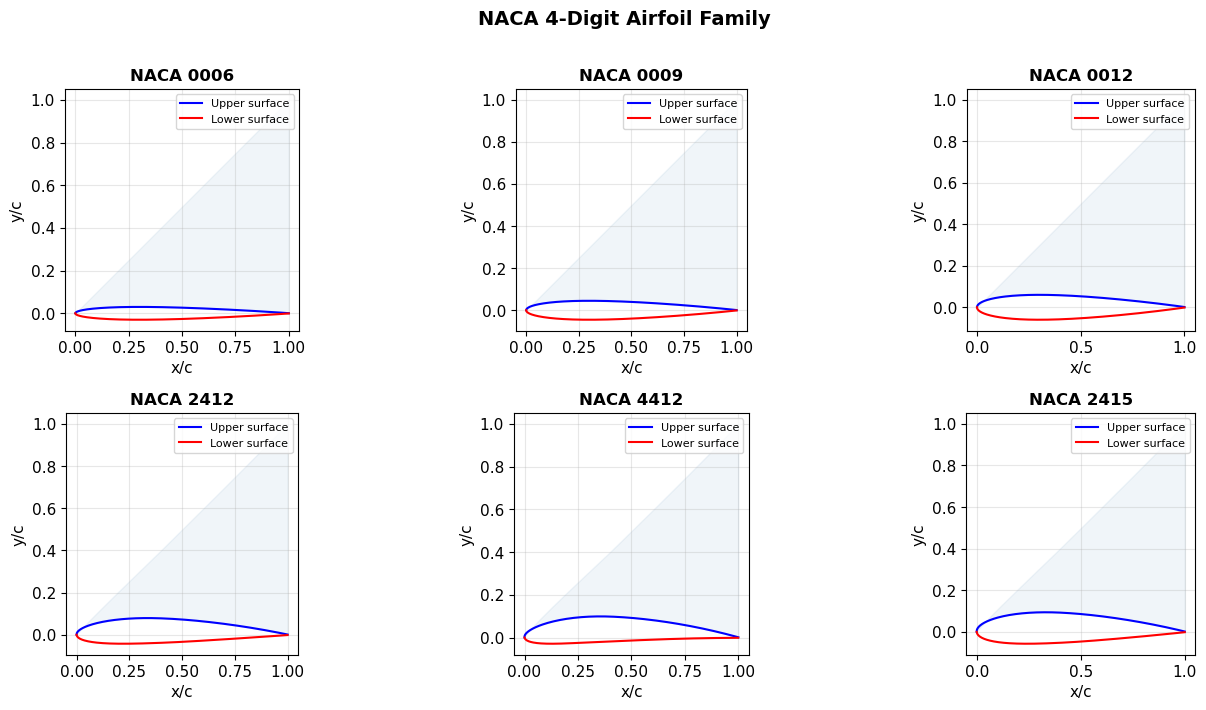
Figure saved as naca4digit_family.png
2. Thickness and Camber Distributions
Let us examine how thickness and camber vary along the chord for NACA 2412.
[3]:
af_2412 = NACAFourDigit('2412', n_points=300)
x = np.linspace(0, 1, 300)

yt = af_2412.thickness(x)
yc, dyc_dx = af_2412.camber_line(x)

xu, yu, xl, yl = af_2412.coordinates()

fig, axes = plt.subplots(1, 3, figsize=(15, 4))

# Airfoil shape
ax = axes[0]
ax.plot(xu, yu, 'b-', linewidth=2, label='Upper')
ax.plot(xl, yl, 'r-', linewidth=2, label='Lower')
ax.plot(x, yc, 'k--', linewidth=1.5, label='Camber line')
ax.fill_between(xu, yu, xl, alpha=0.1, color='steelblue')
ax.set_aspect('equal')
ax.set_title('NACA 2412 Profile', fontweight='bold')
ax.set_xlabel('x/c')
ax.set_ylabel('y/c')
ax.legend()

# Thickness distribution
ax = axes[1]
ax.plot(x, yt * 2, 'g-', linewidth=2)
ax.axhline(af_2412.t, color='k', linestyle=':', alpha=0.5,
           label=f'Max thickness = {af_2412.t*100:.0f}%c')
idx_max = np.argmax(yt)
ax.axvline(x[idx_max], color='r', linestyle='--', alpha=0.7,
           label=f'Location = {x[idx_max]:.2f}c')
ax.set_title('Thickness Distribution', fontweight='bold')
ax.set_xlabel('x/c')
ax.set_ylabel('t/c (full thickness)')
ax.legend()

# Camber line
ax = axes[2]
ax.plot(x, yc, 'purple', linewidth=2)
ax.axhline(af_2412.m, color='k', linestyle=':', alpha=0.5,
           label=f'Max camber = {af_2412.m*100:.0f}%c')
ax.axvline(af_2412.p, color='r', linestyle='--', alpha=0.7,
           label=f'Camber location = {af_2412.p*100:.0f}%c')
ax.set_title('Camber Line', fontweight='bold')
ax.set_xlabel('x/c')
ax.set_ylabel('y_c/c')
ax.legend()

plt.tight_layout()
plt.savefig('naca2412_analysis.png', bbox_inches='tight', dpi=100)
plt.show()
3. Thin-Airfoil Theory: Lift vs. Angle of Attack
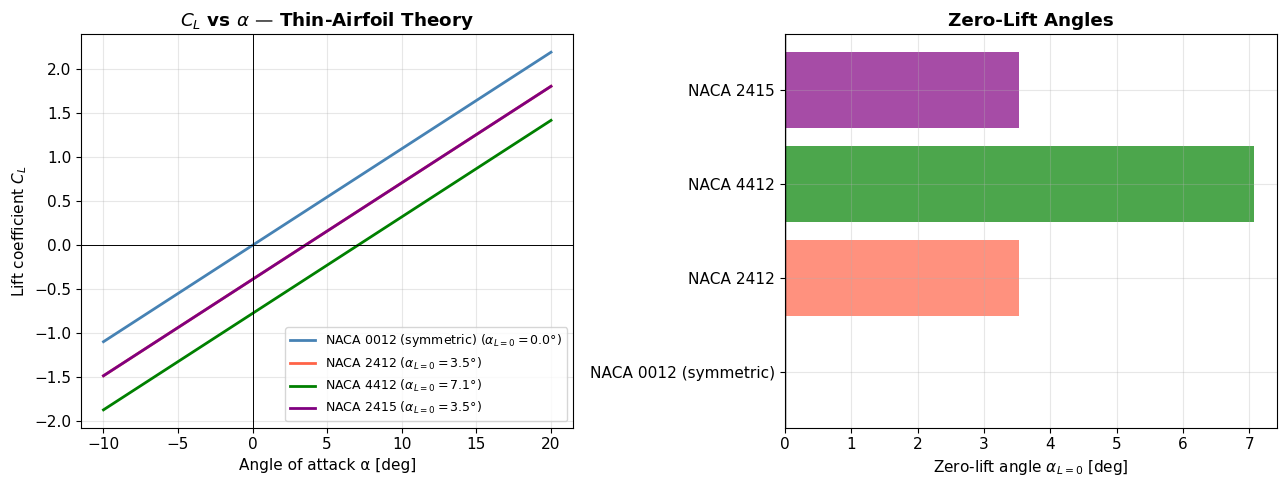
Thin-airfoil theory gives the lift coefficient as:
where \(\alpha_{L=0}\) is the zero-lift angle of attack, which depends on the camber.
For symmetric airfoils (\(m=0\)), \(\alpha_{L=0} = 0\). For cambered airfoils, \(\alpha_{L=0} < 0\) (lift at zero geometric angle of attack).
[4]:
airfoils_compare = {
    'NACA 0012 (symmetric)': NACAFourDigit('0012'),
    'NACA 2412': NACAFourDigit('2412'),
    'NACA 4412': NACAFourDigit('4412'),
    'NACA 2415': NACAFourDigit('2415'),
}

alpha_range = np.linspace(-10, 20, 100)

fig, axes = plt.subplots(1, 2, figsize=(13, 5))

colors = ['steelblue', 'tomato', 'green', 'purple']

# CL vs alpha
ax = axes[0]
for (name, af), color in zip(airfoils_compare.items(), colors):
    CL = [af.cl(a) for a in alpha_range]
    al0 = np.rad2deg(af.zero_lift_angle())
    ax.plot(alpha_range, CL, color=color, linewidth=2,
            label=f'{name} ($\\alpha_{{L=0}}={al0:.1f}°$)')
ax.axhline(0, color='k', linewidth=0.7)
ax.axvline(0, color='k', linewidth=0.7)
ax.set_xlabel('Angle of attack α [deg]')
ax.set_ylabel('Lift coefficient $C_L$')
ax.set_title('$C_L$ vs $\\alpha$ — Thin-Airfoil Theory', fontweight='bold')
ax.legend(fontsize=9)

# Zero-lift angles bar chart
ax = axes[1]
names = list(airfoils_compare.keys())
al0_values = [np.rad2deg(af.zero_lift_angle()) for af in airfoils_compare.values()]
ax.barh(names, al0_values, color=colors, alpha=0.7)
ax.axvline(0, color='k', linewidth=1)
ax.set_xlabel('Zero-lift angle $\\alpha_{L=0}$ [deg]')
ax.set_title('Zero-Lift Angles', fontweight='bold')

plt.tight_layout()
plt.savefig('cl_vs_alpha.png', bbox_inches='tight', dpi=100)
plt.show()

# Print summary
print("\nAirfoil Properties Summary:")
print(f"{'Airfoil':<20} {'m':>6} {'p':>6} {'t':>6} {'α_L0 [°]':>10}")
print("-" * 50)
for name, af in airfoils_compare.items():
    al0_deg = np.rad2deg(af.zero_lift_angle())
    label = name.split()[1]
    print(f"NACA {label:<16} {af.m*100:>5.1f}% {af.p*100:>5.0f}% {af.t*100:>5.0f}% {al0_deg:>10.2f}")
Airfoil Properties Summary:
Airfoil                   m      p      t   α_L0 [°]
--------------------------------------------------
NACA 0012               0.0%     0%    12%       0.00
NACA 2412               2.0%    40%    12%       3.53
NACA 4412               4.0%    40%    12%       7.06
NACA 2415               2.0%    40%    15%       3.53
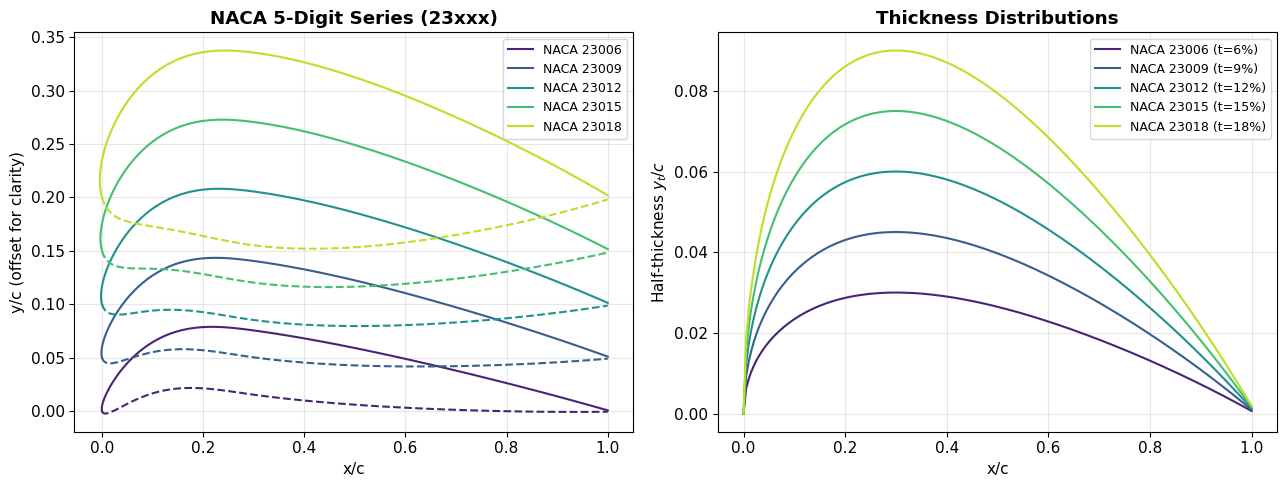
4. NACA 5-Digit Airfoils
The NACA 5-digit series provides higher design lift coefficients for the same thickness. Common examples: 23012, 23015, 23018.
The first three digits encode the design lift coefficient and camber line type.
[5]:
designations_5digit = ['23006', '23009', '23012', '23015', '23018']
colors5 = plt.cm.viridis(np.linspace(0.1, 0.9, len(designations_5digit)))

fig, axes = plt.subplots(1, 2, figsize=(13, 5))

# Profile shapes (offset vertically for clarity)
ax = axes[0]
for i, des in enumerate(designations_5digit):
    af = NACAFiveDigit(des)
    xu, yu, xl, yl = af.coordinates()
    offset = i * 0.05
    ax.plot(xu, yu + offset, color=colors5[i], linewidth=1.5, label=f'NACA {des}')
    ax.plot(xl, yl + offset, color=colors5[i], linewidth=1.5, linestyle='--')
ax.set_xlabel('x/c')
ax.set_ylabel('y/c (offset for clarity)')
ax.set_title('NACA 5-Digit Series (23xxx)', fontweight='bold')
ax.legend(fontsize=9)

# Thickness as function of last two digits
ax = axes[1]
thicknesses = [int(des[3:]) for des in designations_5digit]
for i, des in enumerate(designations_5digit):
    af = NACAFiveDigit(des)
    x_pts = np.linspace(0, 1, 200)
    yt = af.thickness(x_pts)
    ax.plot(x_pts, yt, color=colors5[i], linewidth=1.5, label=f'NACA {des} (t={af.t*100:.0f}%)')
ax.set_xlabel('x/c')
ax.set_ylabel('Half-thickness $y_t/c$')
ax.set_title('Thickness Distributions', fontweight='bold')
ax.legend(fontsize=9)

plt.tight_layout()
plt.savefig('naca5digit_family.png', bbox_inches='tight', dpi=100)
plt.show()
5. Summary
In this notebook we have:
Generated NACA 4-digit airfoil coordinates using the standard thickness and camber formulas
Visualized the airfoil family, thickness and camber distributions
Applied thin-airfoil theory to compute lift curves
Compared cambered vs. symmetric airfoils
Introduced NACA 5-digit series
Key takeaways
Camber shifts the lift curve to the left (negative \(\alpha_{L=0}\))
All thin airfoils have the same lift-curve slope: \(2\pi\) per radian ≈ \(0.1097\) per degree
Thickness does not affect lift in thin-airfoil theory (but affects stall)
Next steps
Proceed to ../02_finite_wing/finite_wing_vlm.ipynb to study finite wing effects.